

Aldi complaint reply arrives with the AI prompt still attached
A Birmingham woman who complained about hairs in an Aldi dip has spoken out after the supermarket’s reply came back with the AI prompt used to write it still attached. The prompt asked for an apology. The reply didn’t include one.
Jo Reeves, from Cotteridge, told the BBC this week that she was disappointed to find the instructions someone had typed into an AI tool sitting inside what was meant to be a customer service response.
She had bought a chicken caesar loaded dip while her partner was in hospital for an operation. She found two hairs in it.
“We were disgusted”
Reeves had popped into her local Aldi for what she called “recovery food” while her partner was in Worcester hospital. She found the hairs while eating the dip.
“We were disgusted and put them in the bin,” she told the BBC. “I can kind of excuse one hair, sort of, but two…”
One hair is unlucky. Two felt like something worth flagging, so she got in touch with Aldi.
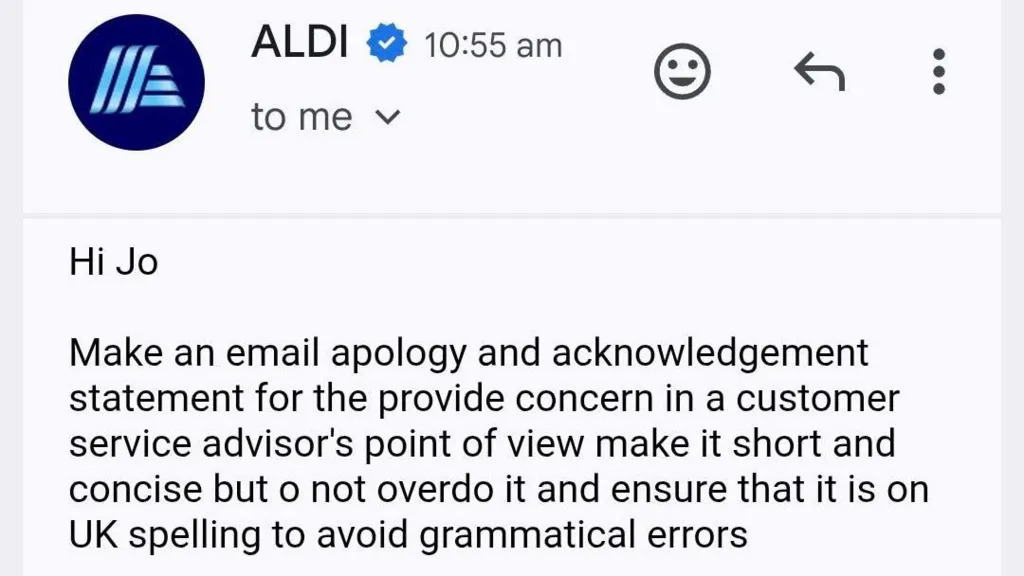
How the Aldi AI prompt ended up in the reply
Aldi did reply. The response offered advice on how to get a refund and told her “we’re taking your feedback seriously”.
But it came with something that was never meant to leave the building: the instruction someone had written to generate it.
The prompt read: “Hi Jo. Make an email apology and acknowledgement statement for the provide concern in a customer service advisor’s point of view make it short and concise but do not overdo it and ensure that it is on UK spelling to avoid grammatical errors.”
Read that once and it hits differently. The reply itself was functional. The brief sitting beside it showed exactly what the reply had been asked to be.
There is also an awkward detail. The instructions asked for an apology. The reply that came with them did not include one.
Reeves said she was not surprised that AI was involved. What bothered her was the tone. “Everyone uses AI but the language is disappointing as a customer,” she said. She added that Aldi might as well have written: “Send an email to a customer who is making a mountain out of molehill, give the bare minimum and keep them sweet.”
With the brief right there in front of her, that reading is hard to dismiss.
A question of authenticity
For Reeves, the bigger problem was what the message said about the brand.
“They always present themselves from a marketing and customer services perspective as genuine and authentic,” she said. “Yet, this is their reply. Disappointing.”
The brief reduced her complaint to a formula. An apology and acknowledgement statement. Short and concise. UK spelling. The words were technical, not personal, and she was reading them during a difficult week.
That gap between what a customer needs and what a template asks for is why the story is travelling.
Did Aldi apologise?
Not in the original reply, but it has since. A spokesperson said: “This response fell well below our normal standards of customer service. We have contacted Ms Reeves directly to apologise and fully resolve the issue she had with our product.”
The wording is careful. Aldi is not defending the message. It treats it as a slip and moves straight to the fix, which is the sensible response once a story like this is public. Whether that repairs the impression the original reply left is a different question.
Shoppers are already tired of AI customer service
The Aldi story lands at a time when public patience with AI in customer service is already thin.
Research from AnswerConnect, based on a survey of 6,000 people across the UK, US and Canada, found that 85% would rather speak to a real person than an AI when contacting a business, up from 83% in its previous survey. Frustration with AI agents has risen from 54% to 59%, and 31% said they would hang up if connected to an AI.
So when a shopper opens a complaint reply and finds the AI drafting brief attached, the technology is not the surprise. It confirms something many customers already assume.
Why this one has stuck
The line doing the damage is “make it short and concise but do not overdo it.” Read once, it lands as an instruction to handle a customer politely and move on. That is what people are reacting to.
The brief is not just clumsy. It is a snapshot of what someone wanted the reply to be. An apology, on paper. A concise one. Nothing more.
Aldi will sort the immediate problem. The issue will be resolved, someone will tighten the process, and the next complaint will not come back with the drafting brief attached. What is harder to fix is the impression the message leaves.
For a supermarket that has built its name on being straightforward and no-nonsense, being caught sending a reply with the AI brief still attached is the kind of story that lingers. Not because it is the worst blunder of the year, but because it puts a name to something plenty of shoppers already suspected: that when they complain, someone somewhere is quietly telling an AI not to overdo it.
Reeves said the reply made her question the company’s authenticity. She will not be the only one asking that question.
What businesses should learn from the Aldi AI prompt mistake
Using AI to draft customer replies is not the problem. Sending drafts nobody has checked is. Four habits would have stopped this reply going out.
- Check every reply before it is sent. An AI draft should reach a named agent, not the customer. A few seconds of human review would have caught the prompt, the missing apology and the tone.
- Keep prompts out of the reply window. Stray instructions end up in replies when the brief is typed into the same box as the message, or pasted in from a notes document. Store standard prompts inside the AI tool itself, so there is nothing to copy across by mistake.
- Let people handle complaints. AI is useful for sorting and routing tickets and for answering routine questions. A complaint, especially one about food safety from someone having a hard week, needs a person to write the reply and the apology.
- Tell customers when AI is involved. In the same AnswerConnect research, 86% of people said companies should clearly say when AI is being used. Being open about it costs little. Being found out, as this story shows, costs a lot more.
This is the model we use at Octatec. AI handles triage, and trained people own the reply and any escalation, across our live chat support and email support services. If you want the speed of AI without replies like Aldi’s reaching your customers, talk to our team.