

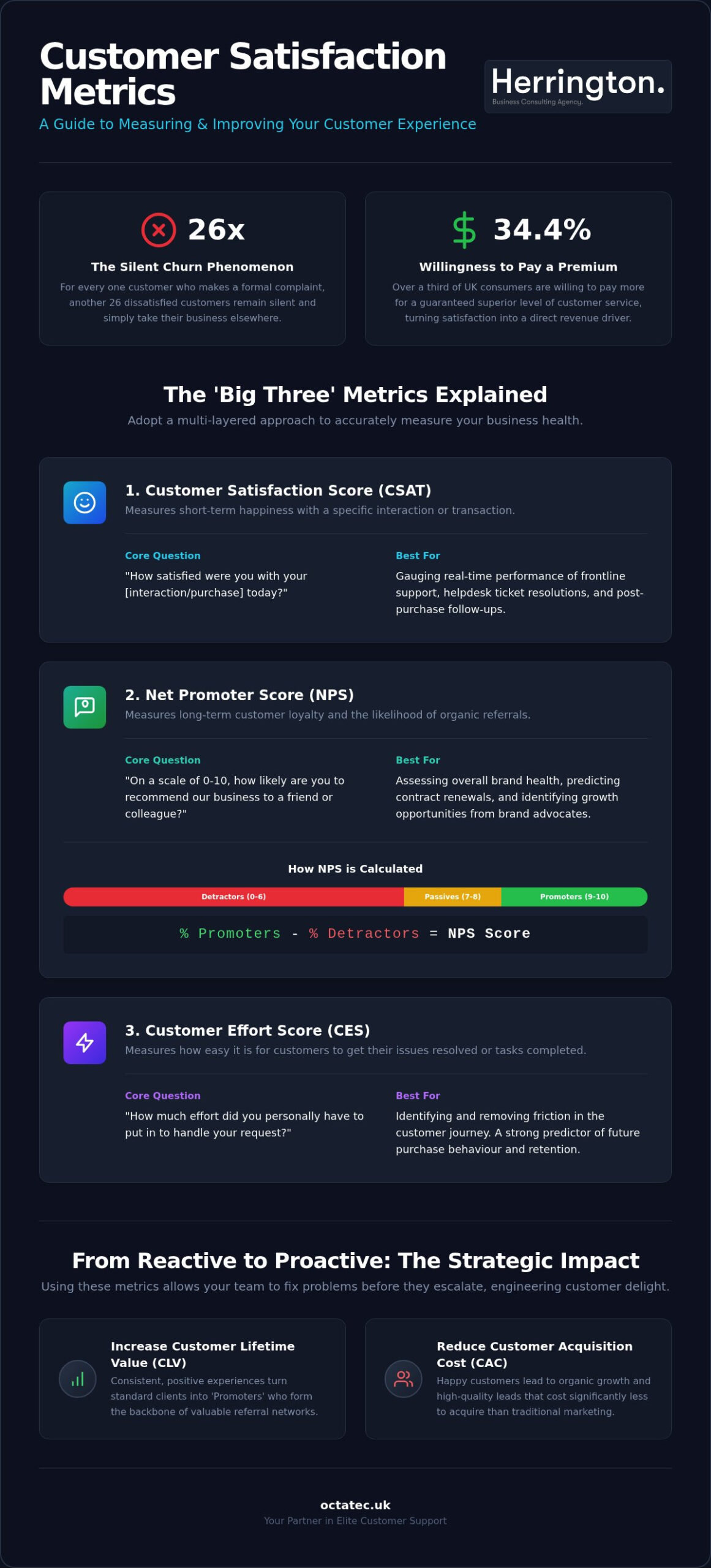
Did you know that 34.4% of UK consumers are now willing to pay a premium for superior service, even as economic pressures mount? For many SMEs in Birmingham and Tividale, the challenge isn’t a lack of data, it’s the absence of actionable insights. You might feel overwhelmed by spreadsheets whilst your team remains too busy to collect consistent feedback, leading to customer churn that feels both sudden and unexplained. It’s a common frustration for growing businesses that want to maintain a personal touch while scaling their operations.
We understand that you need more than just numbers; you need a clear path to improvement. This guide will help you master the essential customer satisfaction metrics needed to measure, analyse, and improve your customer experience to drive long-term business growth. By implementing a disciplined framework, you’ll gain the peace of mind that comes from knowing exactly how your brand is perceived. We will show you how to turn these performance indicators into a strategic advantage that strengthens your reputation and secures higher retention rates across the West Midlands.
Key Takeaways
- Understand the “silent churn” phenomenon and why the vast majority of dissatisfied customers depart without ever raising a formal complaint.
- Master the “Big Three” customer satisfaction metrics—CSAT, NPS, and CES—to establish a standardised framework for measuring your operational success.
- Learn how to select specific indicators that align with your unique business model whilst filtering out vanity data that fails to drive revenue.
- Identify the critical “moments of truth” in your customer journey to implement efficient feedback loops across email, SMS, and in-app channels.
- Discover how 24/7 multi-channel support provides a reliable extension to your team, ensuring consistent brand reputation and higher retention rates.
Why Customer Satisfaction Metrics are Vital for UK Business Growth
For any UK SME, customer satisfaction isn’t just a vague feeling; it’s a measurable asset. Think of customer satisfaction metrics as the quantifiable heartbeat of your organisation. They provide a real-time diagnostic of your business health. These figures show you exactly where you’re thriving and where you’re at risk. Without these numbers, you’re flying blind.
The “silent churn” problem is particularly lethal for smaller firms. Research suggests that for every customer who complains, another 26 remain silent and simply take their business elsewhere. Your absence of complaints isn’t necessarily a sign of success; it’s often a sign of apathy. By tracking customer satisfaction metrics, you can identify these quiet departures before they impact your revenue.
High satisfaction scores also drive down your Customer Acquisition Cost (CAC). With 34.4% of UK consumers now willing to pay more for a higher level of customer service, investing in your existing base is a strategic necessity. For businesses in Birmingham and Tividale, these metrics are the equaliser. They allow local firms to compete with national giants by offering a level of responsiveness that large, faceless corporations can’t match.
The Economic Impact of Happy Customers
Improved retention directly strengthens your bottom line. In the context of long-term support retainers, Customer Lifetime Value (CLV) represents the total revenue a business can expect from a single client account throughout their entire relationship. When you deliver consistent excellence, you turn standard clients into “Promoters.” These individuals form the backbone of organic local referral networks across the West Midlands, providing you with high-quality leads that cost almost nothing to acquire.
Transitioning from Reactive to Proactive Support
Data allows your team to fix problems before the customer even notices a service dip. You can move away from “firefighting” urgent complaints and start “engineering” delight through consistent performance. This shift requires a foundation of 24/7 monitoring. When you have a vigilant system in place, you catch technical glitches or delivery delays in real-time. Proactive care ensures that your brand remains a “safe pair of hands,” building the unwavering trust necessary for long-term growth.
The ‘Big Three’ Metrics: CSAT, NPS, and CES Explained
To truly understand your business health, you must adopt a multi-layered approach to customer satisfaction metrics. Relying on a single data point often results in a skewed perspective of the client experience. Standardising these measurements is crucial for accurate year-on-year comparisons, especially as UK consumer expectations continue to evolve. Measuring user satisfaction across various touchpoints ensures you aren’t blinded by a single positive interaction whilst systemic issues persist elsewhere in the journey.
Customer Satisfaction Score (CSAT)
CSAT is your primary tool for transactional feedback. It asks a simple question: “How was your interaction today?” This metric is ideal for immediate follow-ups after a live chat session or the resolution of a technical helpdesk ticket. Whilst a 1-5 scale provides granular detail, binary (Yes/No) options often yield higher response rates from busy clients. It’s the most effective way to monitor the performance of your frontline support staff in real-time and ensure individual issues are resolved to a high standard.
Net Promoter Score (NPS)
NPS shifts the focus from specific transactions to long-term loyalty. By asking how likely a customer is to recommend your service on a scale of 0-10, you categorise your base into Promoters (9-10), Passives (7-8), and Detractors (0-6). You calculate the final score by subtracting the percentage of Detractors from the percentage of Promoters. In the UK SaaS and B2B sectors, NPS remains the gold standard for assessing the health of ongoing retainers and the likelihood of contract renewals.
Customer Effort Score (CES)
Modern service strategy prioritises ease over excellence. CES measures how much effort a customer had to exert to resolve their issue or complete a task. Reducing friction is often more impactful for retention than trying to “wow” a client with unexpected extras. A low-effort experience is a powerful predictor of future purchase behaviour and a reliable early warning system for potential churn. If you want to ensure your support desk functions as a “safe pair of hands,” you might consider outsourcing to a specialist team that prioritises seamless, low-friction resolution.
Aligning these metrics with specific departments is vital for internal clarity. Sales and account management teams typically thrive on NPS data to identify referral opportunities and expansion leads. Support teams require the immediate granularity of CSAT and CES to refine their technical processes and response times. Using all three creates a comprehensive map of the customer journey, from the initial pitch to the final support ticket. This multi-metric approach gives you the full picture of your operational efficiency and brand reputation.
Choosing the Right Metrics for Your Industry Sector
A “one-size-fits-all” approach to customer satisfaction metrics often fails because different sectors have distinct customer lifecycles. A SaaS founder in Tividale needs different insights than an Airbnb host in Birmingham. The latest UK Customer Satisfaction Index (UKCSI) report from July 2026 shows a national average of 78.3 out of 100. Whilst this indicates a slight improvement from 2025, growth has plateaued. If you’re in the financial sector, the bar is even higher; banks and building societies reached a record score of 82.0 this year.
You must look beyond vanity metrics like total social media followers or website hits. These figures look good on a board report but don’t drive revenue if your core support experience is failing. Instead, balance these numbers with qualitative “voice of the customer” data. Reading the actual words used in feedback helps you understand the reason behind the score. This combined approach ensures you aren’t just chasing a number but are actually improving the service you provide.
Metrics for SaaS and Fintech Startups
In high-growth tech sectors, you should prioritise the Customer Effort Score (CES). If your platform isn’t intuitive, users will churn regardless of your feature set. You want to ensure that using your product is seamless. Once you’ve established a stable user base, use NPS to identify your power users. These are the clients most likely to provide the case studies and testimonials that fuel your sales pipeline. We also recommend tracking “Time to First Response” as a secondary driver. In the fast-paced fintech world, a slow initial reply can destroy trust before a technical expert even looks at the ticket.
Metrics for E-commerce and Property Management
For property managers and online retailers, the Customer Satisfaction Score (CSAT) is king. This is especially true for Airbnb guest communication, where a single bad interaction can ruin a stay and result in a negative review. You need to measure response accuracy and First Contact Resolution (FCR). Solving a guest’s problem on the first try is the most effective way to protect your reputation. Octatec’s 24/7 presence ensures these metrics remain high even during “out of hours” periods. When a guest has an issue at 2 am, our team provides an immediate, expert response. This constant vigilance prevents small issues from escalating into brand-damaging complaints.
How to Organise and Implement a Feedback Loop
Implementing a feedback loop transforms customer satisfaction metrics from static numbers into a dynamic engine for growth. This process requires a disciplined, five-step approach to ensure your data is both accurate and actionable. By creating a structured system, you move away from guesswork and towards evidence-based decision-making.
- Step 1: Identify “moments of truth.” Pinpoint the exact stages in your journey where customers form their strongest opinions, such as the conclusion of a technical support ticket or the delivery of a new service.
- Step 2: Select your channel. Whilst email is traditional, SMS or in-app surveys often capture higher response rates for transactional feedback in fast-paced sectors.
- Step 3: Automate the collection. Using a system that triggers surveys automatically prevents your team from cherry-picking only the happiest clients, which would skew your results.
- Step 4: Establish a “closed-loop” process. You must follow up with detractors immediately to resolve their concerns and prevent negative word-of-mouth.
- Step 5: Review trends. Base your strategic decisions on long-term patterns rather than reacting to individual outliers.
Designing Effective Survey Questions
The “Less is More” rule is vital for high participation. Shorter surveys always yield better response rates because they respect the client’s time. Use a helpful, professional tone and stick to British English conventions to maintain brand consistency. When asking open-ended questions, be specific. Instead of asking for “any other comments,” ask “what is the one thing we could have done differently today?” This phrasing encourages actionable qualitative feedback that your team can actually implement.
Analysing and Distributing the Data
Transparency is key to improvement. Create dashboards that your entire team, or your outsourced support partner, can access in real-time. For most UK SMEs, monthly reviews provide the right cadence to catch issues without being buried in data. Thematic Analysis involves categorising qualitative text-based feedback into recurring groups, such as “response speed” or “technical accuracy,” to identify systemic operational weaknesses. This methodical approach ensures your feedback loop remains a practical utility rather than a bureaucratic exercise. When everyone sees the data, the entire organisation becomes aligned with the goal of increasing retention and brand reputation.
Maintaining Elite Satisfaction with an Outsourced Support Partner
Managing customer satisfaction metrics is a full-time commitment that many internal teams simply cannot sustain whilst handling core business functions. A dedicated outsourced partner acts as a “safe pair of hands,” ensuring your brand reputation remains protected at all hours. By providing 24/7 multi-channel support across phone, email, and live chat, we ensure that every customer interaction is high-quality and responsive. This constant availability is a primary driver for higher CSAT scores, as customers feel valued when their issues are addressed immediately, regardless of the time of day. Professional Managed Service Providers (MSPs) like Octatec are fundamentally incentivised to keep your metrics at peak levels because our success is directly tied to yours.
Removing the administrative burden of data collection and analysis from your internal staff allows your core team to focus on high-level strategy whilst we handle the operational heavy lifting. This ensures that the feedback loop remains consistent and unbiased, providing you with a reliable stream of insights to fuel long-term business growth. When a specialist team monitors your performance indicators, you gain the peace of mind that comes from unwavering reliability and expert-level skill.
The Octatec Approach to Customer Success
We employ specialist L1-L3 engineers to ensure that technical issues are resolved correctly the first time. This focus on accuracy directly supports the “right first time” standard that 83.2% of UK customers now expect. Our virtual assistants also handle meticulous CRM upkeep, ensuring that your customer data remains accurate and accessible. As an “Expert Extension” of your business, we don’t just report your customer satisfaction metrics; we actively work to improve them through disciplined, proactive service delivery that functions as a natural part of your organisation.
Scaling Your Support Without Compromising Quality
Maintaining consistency is essential as you scale your operations across Tividale, Birmingham, and the wider West Midlands. Our local expertise, combined with a global-standard 24/7 vigilance model, ensures that no detractor goes unanswered. Whether it is a late-night email or a weekend support ticket, our team is always on, ready to turn a potential negative experience into a positive one. For businesses struggling with high volumes of customer correspondence, professional outsourced email support services can ensure every message is handled with precision and consistent brand tone, even outside of standard business hours. This proactive approach prevents small frustrations from escalating into formal complaints under the latest UK data protection regulations. Discover how Octatec can transform your customer satisfaction metrics today and secure the peace of mind that comes from a high-performance support utility.
Elevate Your Service Strategy Today
Mastering customer satisfaction metrics is the first step towards transforming your business from a reactive service provider into a proactive market leader. Precision drives performance. By standardising your approach with the “Big Three” metrics and implementing a disciplined feedback loop, you ensure that every client interaction contributes to long-term growth. This data-driven strategy provides the clarity needed to reduce churn and build an unshakeable brand reputation across the West Midlands and beyond.
Maintaining this level of vigilance requires constant attention that many internal teams struggle to provide. Our UK-based expert teams specialise in SaaS and Property Management, offering a “safe pair of hands” to manage your support ecosystem around the clock. With 24/7 support availability, we ensure that your performance indicators remain at peak levels whilst you focus on scaling your core operations.
Book a Free Consultation with Octatec to Scale Your Support and discover how our Expert Extension model can secure your peace of mind. We look forward to helping you engineer a superior customer experience that drives lasting success.
Frequently Asked Questions
What is the most important customer satisfaction metric for a small business?
The most important metric depends on your specific industry sector and customer lifecycle. For property managers in Birmingham, the Customer Satisfaction Score (CSAT) is often vital because it measures immediate reactions to guest communications. However, SaaS startups in Tividale often prioritise the Customer Effort Score (CES) to ensure their platforms remain intuitive. Establishing a baseline with at least one of these customer satisfaction metrics is the first step toward building a reliable growth strategy.
How often should I send out NPS surveys to my clients?
You should typically send NPS surveys to your clients on a quarterly or biannual basis. Sending them too frequently can lead to survey fatigue, whilst waiting too long might cause you to miss critical shifts in sentiment. For businesses in Oldbury and Dudley, a quarterly cadence provides enough data to spot trends without overwhelming your contacts. This schedule allows your team to implement changes and measure their impact effectively before the next round of feedback begins.
Can I use an outsourced team to manage my customer satisfaction surveys?
Yes, you can certainly use an outsourced partner to manage and analyse your surveys. Professional MSPs like Octatec function as an “Expert Extension” of your business, handling the administrative burden of data collection. Our teams in Tividale and Birmingham don’t just report the numbers; they provide the 24/7 vigilance needed to act on the results. This ensures your customer satisfaction metrics remain accurate and consistent without draining your internal resources or distracting your core staff.
What is a good CSAT score for a UK-based service business?
A good CSAT score for a UK service business typically falls between 75% and 85%. According to the July 2026 UK Customer Satisfaction Index, the national average is currently 78.3 out of 100. If your business in Aston or West Bromwich is consistently hitting above 80%, you are performing well compared to national benchmarks. Aiming for this elite bracket ensures your reputation remains strong and your retention rates stay high in a competitive local market.
How do I handle a very low NPS score from a key client?
You must address a low NPS score from a key client immediately through a “closed-loop” follow-up process. Contact the individual within 24 hours to understand their specific frustrations and demonstrate that their feedback is valued. This proactive approach often turns a detractor into a loyal advocate. For firms in Birmingham, having a dedicated support partner ensures these critical alerts are caught in real-time, allowing for swift resolution before the relationship is permanently damaged.
What is the difference between CSAT and NPS?
The primary difference lies in the scope of the feedback. CSAT is transactional, measuring a customer’s happiness with a specific interaction, such as a technical helpdesk ticket. In contrast, NPS is relational and measures long-term loyalty by asking how likely a client is to recommend your brand. Whilst CSAT tells you how you performed today, NPS provides a broader view of your business health and the likelihood of future contract renewals.
How can 24/7 support improve my customer effort score (CES)?
24/7 support improves your Customer Effort Score (CES) by removing time-based barriers to issue resolution. When a client in Tividale or Dudley can reach a technical expert at 3 am, the friction of waiting for “business hours” is eliminated. Our L1-L3 engineers ensure that complex problems are solved correctly the first time. This immediate availability makes the support process feel seamless and low-effort, which is a powerful predictor of future purchase behaviour.
Is it better to use emojis or numbers in my satisfaction surveys?
It is generally better to use numbers for professional B2B surveys, as they provide clearer data for statistical analysis. However, emojis can increase response rates for quick transactional CSAT surveys in sectors like e-commerce or property management. For businesses across the West Midlands, the choice should align with your brand voice. Numbers offer precision for long-term tracking, whilst emojis provide a helpful, approachable feel that can encourage participation from busy customers.